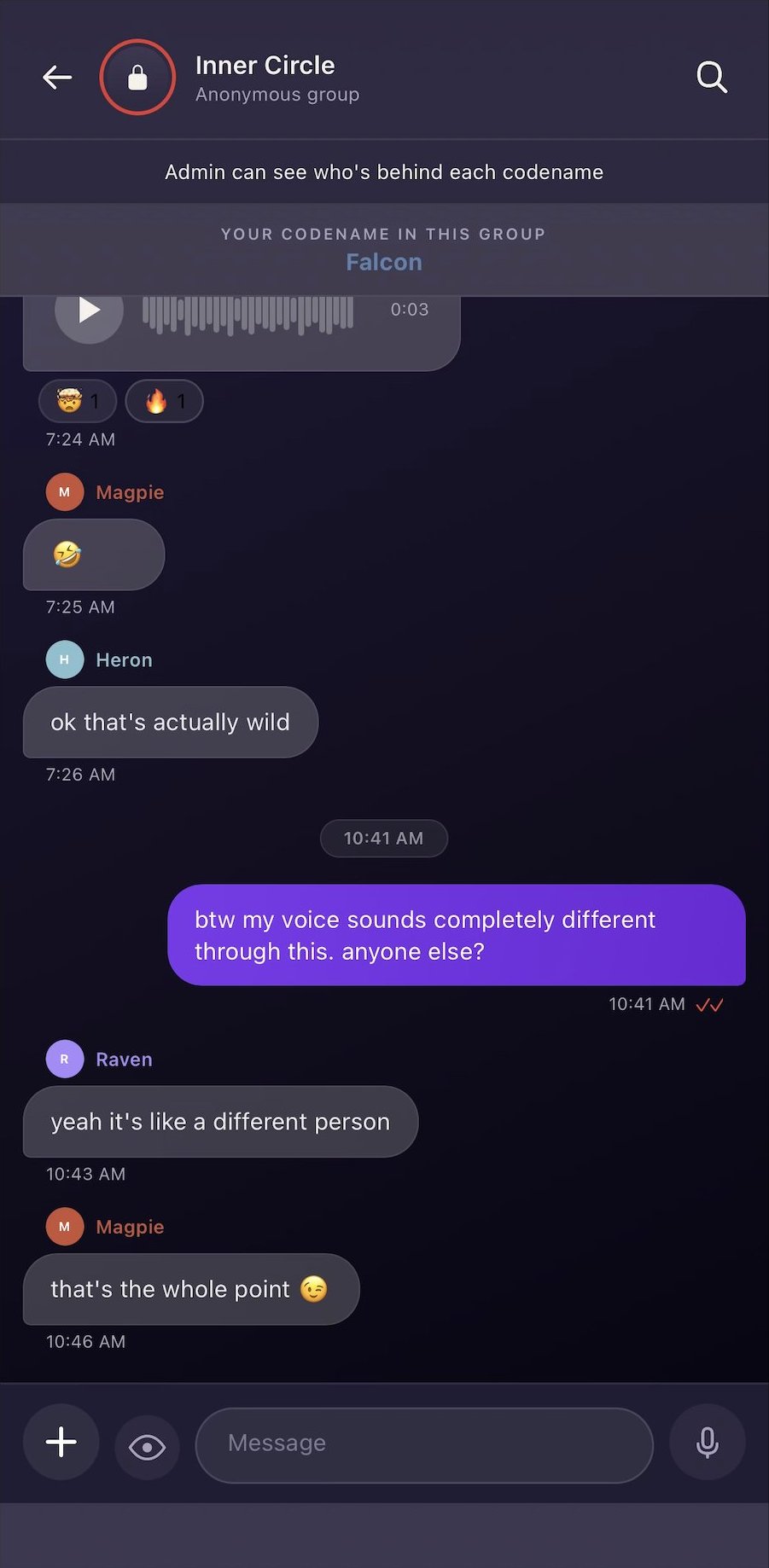
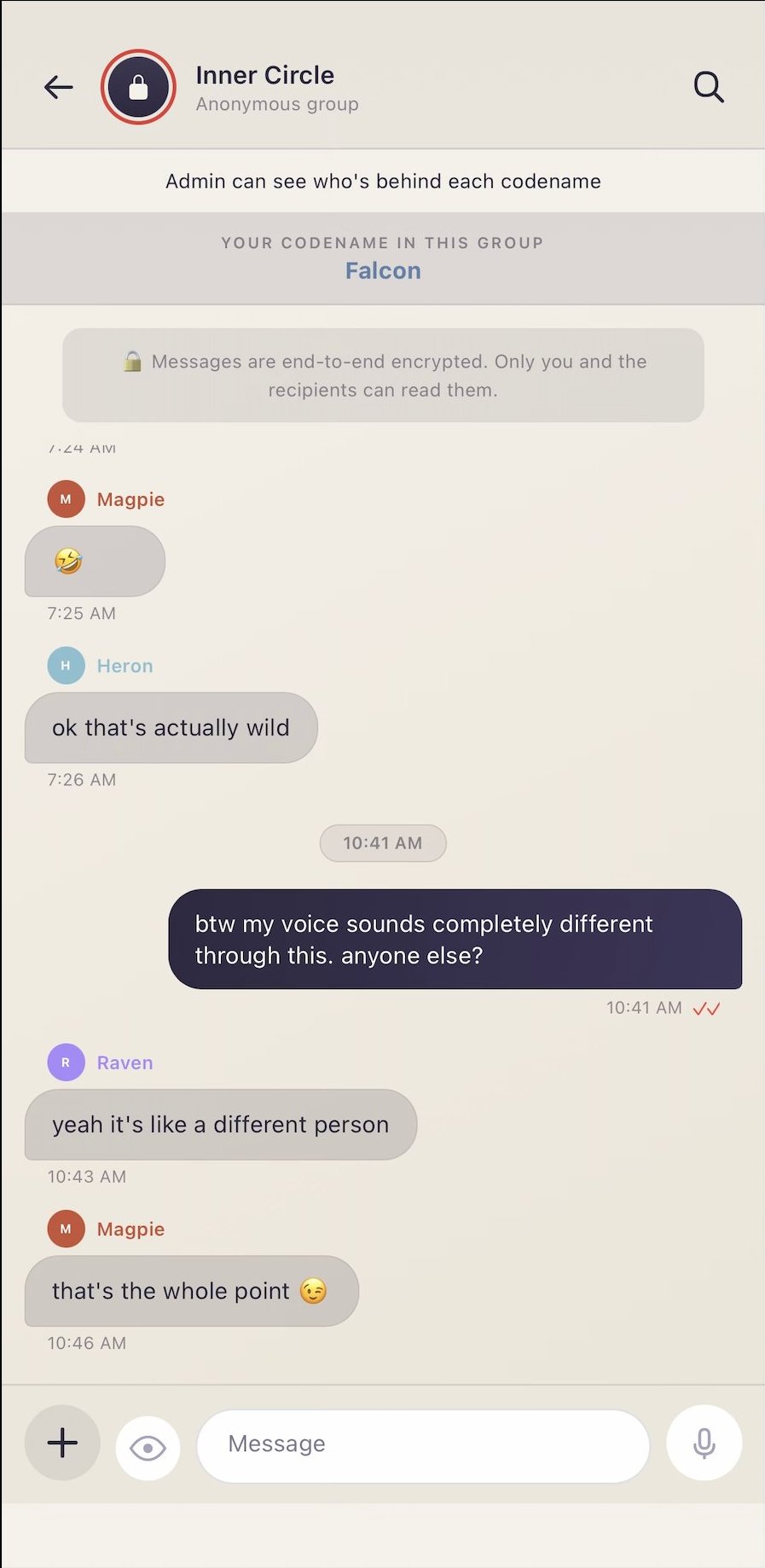
Anonymous group chats for boards, founder peer circles, brokered negotiations, and the friend groups that need to talk straight. Real people you trust. Codenames in place of names. The host runs the room.

Some conversations need everyone in the room — but not everyone's name on what gets said. Covrd gives those rooms a place to happen.
Covrd started as a private channel between a property buyer and seller — kept anonymous while terms got worked out. The same shape works for any deal needing both parties talking before names go on contracts. The host runs the room. Identities surface when both sides agree.
Founders comparing notes with founders. Leaders from rival firms talking hiring, salary, what's actually happening on the inside. The conversation only works because nobody knows whose company is whose. People have done this on Signal for years — Covrd gives them somewhere built for it.
Football banter that lands harder under aliases. Wedding plans where the honest votes surface because nobody's tracking who said what. Group holiday picks that don't quietly turn personal. Same humans, no points-scoring.
You're always known to your host. Codenames sit between members — not between you and the room.

Anonymous rooms are invite-only. The host curates who's in, like running an off-the-record dinner. Members see codenames in place of names and a brand colour in place of a face.
What gets protected is what's said — not who's there. Everyone trusts the room they're in. Just not which line came from which one of them.
In an anonymous room, voice notes are processed and resynthesised in a different voice before they reach anyone else. You record naturally; the room hears someone else entirely.
The original recording is destroyed after synthesis. No-one — not the room, not us — ever hears your real voice.
Photo and video stories that vanish after a day. Drawing tools, text overlays, dynamic colour palettes pulled from your photo. Share with everyone — or just your Close Friends.
Notes, images, voice memos, passwords, calendar events, links, documents. Everything lives behind a Face ID gate, separate from your chats.
Set messages to vanish on a schedule. Or send view-once — opens once, then it's gone.
Calls between mutual contacts only. CallKit on iOS. Cloudflare-relayed when peer-to-peer fails.
Poll your room; see only the percentages. Nobody learns who voted what — including the host.
Privacy products only work if the claims are honest. Here's the current state, including what's not yet ready.
TestFlight invites. TLS in transit. Server-side storage on Supabase, EU.
Signal protocol (PQXDH, post-quantum). Messages and voice notes. Hardening in progress.
External cryptography review before public launch. Full results published.
App Store release. Audited E2E as a core marketing claim.
Database, storage, voice synthesis — all inside the EU. GDPR-compliant by design.
Username. Phone (optional, hashed). Messages. Push tokens. Crash data. That's it. Full policy →
One button removes your account, profile, contacts, codenames, vault, and stored media. Cascading.
| Feature | Covrd | Signal | Telegram | |
|---|---|---|---|---|
| Anonymous rooms with curated members | ✓ | — | — | — |
| Voice note re-synthesis | ✓ | — | — | — |
| Anonymous polls (private voting) | ✓ | — | — | ✓ |
| Personal vault (Face-ID locked) | ✓ | — | — | — |
| Disappearing & view-once messages | ✓ | ✓ | ✓ | ✓ |
| Stories that disappear | ✓ | ✓ | — | ✓ |
| End-to-end encrypted messages | ✓ | ✓ | ✓ | — |
| Independently audited cryptography | Scheduled | — | ✓ | — |
People running rooms where what gets said matters more than who said it. Property brokers wiring buyer and seller before names exchange. Founders comparing real numbers with peers. Boards giving a CEO honest feedback. Leadership teams running 360s. Friend groups that need to talk straight without points-scoring. The pattern is the same: a curated room, a host who knows everyone, members who speak under codenames.
The host sees the mapping of codenames to real identities. Members do not. This is what makes the room work — the host curated who's in, and members trust them to. Everyone is told this upfront; the disclosure sits permanently at the top of every anonymous room. The host is not us, and not a moderator — it's whoever started the room.
Covrd is built by James Vann — solo founder and the engineer behind the product. It exists on a simple conviction: privacy shouldn’t mean trusting a company to behave. It should sit with the person sending the message. Every feature decision traces back to that.
Yes. Messages and voice notes are end-to-end encrypted using the Signal protocol — specifically PQXDH, its post-quantum variant, the same family of cryptography behind Signal and WhatsApp. We’re still hardening the implementation, and an independent third-party audit is scheduled before public launch. We’ll publish the full results when it’s done.
When you record a voice note in an anonymous room, the audio is processed by a speech-synthesis service that re-voices it in a different voice. The synthesised version is delivered to the room. Your original recording is deleted after synthesis. No-one in your room — including the host — hears your real voice.
Yes. Settings → Account → Delete Account removes your profile, contacts, codenames, vault contents, and stored media within 30 days. Messages you sent in conversations with others may remain in their chat histories, but they'll appear as sent by "Deleted user" — your identity is fully detached.
Protected: message and voice-note content, end-to-end encrypted — we can’t read it. The codename-to-identity mapping is visible only to the room’s host. What is not protected, and we’re upfront about it: metadata — who is in a room and when messages are sent — is visible to us, the same as any messenger. Voice synthesis is processed on UK infrastructure before the original is destroyed. We don’t sell data, share it with advertisers, or train models on it. A full independent audit is scheduled before public launch.
Our database and storage run inside the EU. Voice processing runs on UK infrastructure; the original recording is destroyed after synthesis. Crash reports go to EU infrastructure. We don't share data with advertisers, and we don't use it to train models.
Covrd is in private beta. Email us for a TestFlight invite — we're rolling out slowly, on purpose.